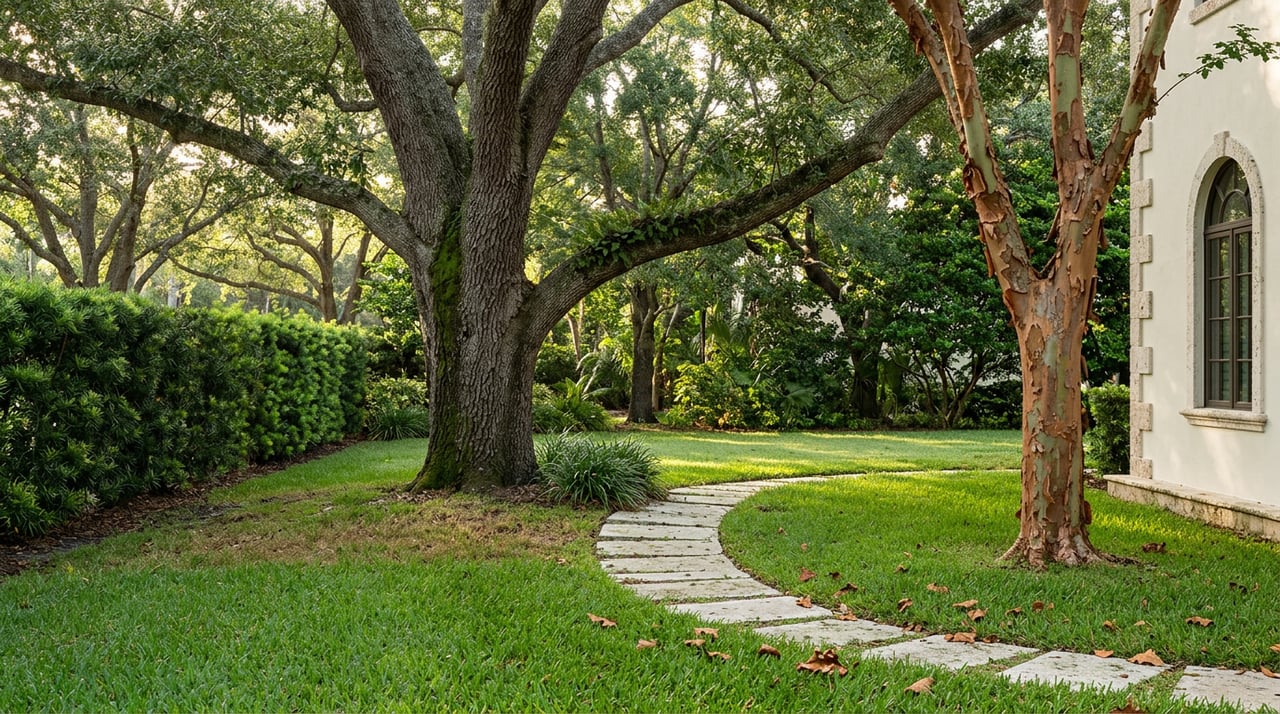
On a Tuesday night in May 2026, Miami's Historic and Environmental Preservation Board heard three unrelated requests to clear trees from Coconut Grove properties. Two were denied outright. The board voted unanimously to block the removal of a royal poinciana and a golden shower on Swanson Avenue in North Grove, and split 4-2 to overturn a permit for 15 trees on El Prado Boulevard in South Grove, rejecting the owner's argument that the trees blocked sightlines at an intersection. The third request, to clear 57 trees on Grand Avenue for a padel and pickleball complex, went through anyway. Not because the board approved of it. The appeal challenging it was thrown out on a technicality: the person who filed it didn't live close enough to have standing.
Same board, same month, same city code. Three different outcomes. If you're pricing a Coconut Grove lot right now, that unpredictability is the fact that matters more than the median.
The Headline Number Everyone's Already Seen
By mid-2026, the Grove's median single-family sale price sat around $2.6 million over the trailing three months, up 52.7 percent from the same period a year earlier, with homes moving at roughly $909 per square foot and typically taking about 87.5 days to sell. Some market reports put the trailing figure closer to $3.4 million depending on which comps are pulled into the window. Both readings are directionally true and both are shaped by mix. A handful of waterfront trophy closings, including one Munroe Drive sale that closed in January 2026 at nearly $6,913 per square foot, pull the average toward numbers that don't describe a typical Grove transaction.
That's the first thing worth unlearning. The median tells you what happened to trade. It does not tell you what a specific lot can support, because in the Grove, two properties with identical square footage and nearly identical asking prices can carry entirely different amounts of usable land once the tree canopy is factored in.
Where the Value Actually Sits
Florida's Save Our Homes provision caps annual assessment increases on homesteaded property at 3 percent, and roughly 72 percent of Grove single-family homes are homesteaded, with more than a third held for over a decade. That combination has quietly widened the gap between what a lot is assessed at and what it would fetch on the open market. Property records through May 2026 show that on 87 percent of Grove single-family parcels, land value alone now exceeds the total tax assessment on the property. Analysts tracking the neighborhood identified 580 parcels as strong teardown candidates, 276 of which carry land value above $1 million on their own. One Main Highway parcel carries close to $51.8 million in land value alone, before a single structure is counted.
The median Grove lot runs about 7,500 square feet, with more than 31 percent sitting at 10,000 square feet or larger. On paper, that's a lot of dirt with a house that's often incidental to the number.
This is also why the Grove's premium over its neighbors is real and not just branding. Trophy inland product in Coconut Grove and neighboring Ponce Davis has been trading at roughly $2,000 to $2,150 per square foot as of early 2026, compared with about $1,700 in inland Coral Gables and $1,200 to $1,300 in Pinecrest and South Miami, where lots tend to be larger relative to price. Buyers are not simply paying more to live in the Grove. They're paying for scarce, already-cleared or lightly-treed buildable land in a neighborhood where clearing land is neither quick nor guaranteed.
| Area | Trophy price per square foot (Q1 2026) |
|---|---|
| Coconut Grove / Ponce Davis | $2,000 to $2,150 |
| Coral Gables, inland | approximately $1,700 |
| Pinecrest / South Miami | $1,200 to $1,300 |
The Line Item Nobody Underwrites
Here is the part that doesn't show up in a comp sheet. Coconut Grove sits inside the city's Neighborhood Conservation Districts, and its Conservation Plan treats tree canopy as part of the neighborhood's protected character, not as landscaping. Any demolition permit application has to be referred to the city's Planning Department for review under the Tree Preservation Ordinance, and the submittal has to include a tree survey by a certified arborist along with a buildable footprint diagram that identifies exactly which portions of the lot can be developed. If the proposed demolition preserves more than 50 percent of the original structure, that referral isn't required. A true teardown doesn't get that exemption.
Even once you clear that hurdle, lot coverage in most T3-R zones caps at 50 percent of the ground floor, with an additional 15 percent available only if the design incorporates qualifying buffer trees, defined under the code as Florida Grade 1 specimens at least 20 feet tall with an 8-foot clear trunk and a 10-inch trunk diameter. Smaller lots under 10,000 square feet carry a minimum 30 percent green space requirement on top of that. None of this shows up in a listing description, and none of it is optional once a lot is inside the conservation overlay.
The spring 2026 cases show how this plays out when it's contested rather than assumed. The El Prado Boulevard owner proposed mitigating the 15-tree removal by planting 19 hardwoods and 12 palms, but concentrated nearly all of them in a narrow strip along the back of the lot, out of public view. The board rejected that plan specifically because of where the replacement trees would go, not just how many there were. As of mid-May 2026, the city's own list of pending decisions showed five active Grove tree cases, including a permit request to remove 13 trees at 3301 McDonald St., two of them specimen-protected: a Norfolk Island pine and a strangler fig. Each of those properties looked, from the street or from a listing photo, like ordinary redevelopment candidates. Each carried a materially different amount of friction between contract and permit.
Building costs on the other side of that friction are not small. Grove lots run from roughly 6,000-square-foot infill parcels to 20,000-square-foot North Grove estate sites, and construction runs $800 to $1,700 per square foot depending on waterfront exposure and finish level, with total project costs typically landing between $4 million and $20 million. A buildable footprint diagram that shrinks your usable envelope by 15 or 20 percent changes that math before a single permit is pulled.
The Rules Are Being Rewritten While You're Shopping
None of this is settled law, either. The City of Miami didn't actually establish its Tree Ordinance Advisory Committee until May 2026, nearly a year after a commissioner first proposed it, and the eleven-member panel, two appointees from each commission district plus one at-large member, including North Grove arborist Ian Wogan as the District 2 representative, didn't hold its first working session until the formal review launched in July 2026. The committee's charge is to spend eight months reconciling two competing goals: easing what many homeowners see as an unreasonably slow permitting process for routine tree work, while tightening enforcement against developers who treat tree fines as a cost of doing business. Recommendations aren't due back to the City Commission until March 2027. City and county officials have set a goal of 30 percent tree canopy coverage by 2030, but current estimates put actual coverage at 17 to 20 percent, with little measurable progress in recent years.
Separately, a state law passed in 2026, House Bill 803, now exempts certain residential work under $7,500 from needing a building permit at all, effective July 1, 2026. It sounds like relief, but it excludes electrical, plumbing, structural, mechanical, and gas work regardless of cost, doesn't apply in flood hazard areas, and has no bearing on the Certificate of Appropriateness process or the tree ordinance. It changes very little for anyone actually planning a Grove teardown or major addition.
The practical upshot: a buyer underwriting a Grove lot today is pricing against a set of rules that could look different by the time a permit application actually reaches the counter.
What to Ask Before You Write an Offer
- Request the arborist tree survey and buildable footprint diagram before you're under contract, not after.
- Confirm the parcel's specific NCD subzone, since T3-R, T3-L, and T3-O carry different lot coverage and setback allowances.
- Ask whether the existing structure retains more than 50 percent of its original form, since that single threshold determines whether a demolition waiver referral is triggered at all.
- Check the city's list of pending tree removal decisions for the address and its immediate neighbors, since a live appeal window can add months to a timeline you were counting on.
A Few Questions Worth Answering Directly
If a lot is flagged as a strong teardown candidate on paper, does that mean I can clear it? Not automatically. Land value exceeding assessed value tells you what the dirt is worth to the market. It says nothing about how much of that lot survives a tree survey and buildable footprint review once you apply for the permit.
Does keeping part of the existing house avoid the tree review entirely? It avoids the demolition waiver referral, specifically when more than 50 percent of the original structure is preserved. It does not exempt individual trees from separate protection if they're classified as specimen or buffer trees under the code.
Will the ordinance rewrite make this easier for buyers? Nobody knows yet, including the people writing it. The advisory committee's recommendations aren't due until March 2027, and the two sides pushing it have opposite goals. Treat current rules as the ones you're underwriting against, not the ones you'll eventually get.
A Grove lot's price tag tells you what the market thinks the land is worth. It does not tell you what you're allowed to do with it, and in a neighborhood where the canopy is treated as historic fabric rather than landscaping, that gap is where deals get expensive or get stuck. If you're comparing a Grove teardown against something in Coral Gables or Pinecrest, or trying to read what a specific lot's tree canopy actually means for your build plan, that's exactly the kind of groundwork worth doing before you write an offer, not after.
Alexandra Zeidan works with buyers and investors across Coconut Grove and the surrounding neighborhoods on exactly this kind of due diligence. Schedule a Private Consultation to walk through a specific lot, its NCD zoning, and what its canopy actually allows before you commit.